Second Ministerial Conference
The Second Ministerial Conference on Civil Registration and Vital Statistics in Asia and the Pacific took place from 16 to 19 November 2021. A core description of the topics of the conference can be found here.


The United Nations Economic and Social Commission for Asia and the Pacific (ESCAP), in collaboration with the United Nations Economic Commission for Africa (ECA), will organize the second CRVS Research Forum on 30 March - 1 April 2026 in Bangkok, Thailand.
Read More
Members and Associate Members of ESCAP have undertaken a review of their progress since the inception of the Asia Pacific CRVS Decade in 2014. Data from questionnaires distributed in 2024 to National CRVS focal points have been compiled into a Report on the 2025 Review of Progress Made on Civil Registration and Vital Statistics in Asia and the Pacific After a Decade of Getting Every One in the Picture.
Read More
The CRVS applied research training (CART) initiative focuses on enhancing CRVS systems through supporting applied research on strategies, interventions, and tools. This involves designing projects to address practical questions, employing robust methodologies, and identifying key personnel for effective implementation and publication. The need to strengthen practitioners' research capacity is evident, as highlighted in the Asia-Pacific CRVS research forum held in 2023.
Read More
To meet the targets of the CRVS Decade, a Business Process Improvement approach can help improve and streamline Civil Registration and Vital Statistics (CRVS) system. The CRVS Systems Improvement Framework help CRVS stakeholders assess, analyze and redesign, to improve user experience and produce timely vital statistics.
Read MoreThe CRVS community in Asia and the Pacific has reflected on where it stands at the midpoint of the CRVS Decade (2015-2024) during the Second Ministerial Conference. Following this celebration of progress, many of our partners and member countries are leading actions to fill the remaining gaps. To learn more about CRVS in Asia and the Pacific, please subscribe to our newsletter, which offers a monthly panorama of CRVS actions throughout the region Previous editions can be found here. |

The Second Ministerial Conference on Civil Registration and Vital Statistics in Asia and the Pacific took place from 16 to 19 November 2021. A core description of the topics of the conference can be found here.

CRVS Insight brings its readers the most relevant CRVS-related news from around Asia-Pacific.

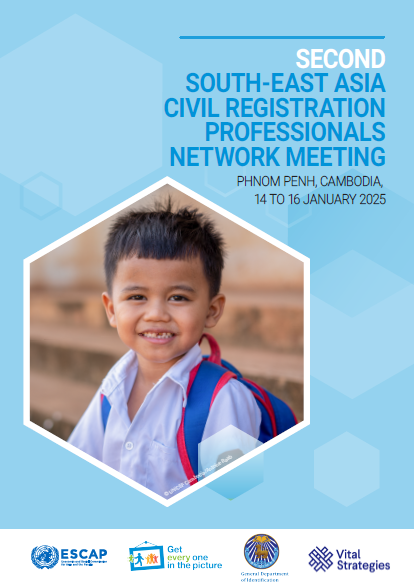
This report captures the discussions and experience sharing among South-East Asian civil registrars and development partners on CRVS progress in South-East Asia during the second in-person meeting of the network from 14 to 16 January 2025 in Phnom Penh, Cambodia, as well as focus areas and future activities for the network.
Our community newsletter puts a spotlight on people who have gone above and beyond in their efforts to support CRVS programmes in Asia and the Pacific, raise awareness of CRVS issues or lead CRVS improvement efforts in their home country or in the region. This month, we would like to dedicate this issue of Insight to Jin Shan.
What is your current title and role?
Following the success of its soft launch for BruneiID App in November 2025, Ministry of Home Affairs (MOHA) and the Ministry of Transport and Infocommunications (MTIC) of Brunei Darussalam have officially rolled out the national digital identity system that functions as an electronic form of personal identification for individuals.
Japan’s digital identity system reached a pivotal milestone as Matsumoto Hisashi, Minister for Digital Transformation, confirmed that more than 100 million My Number Cards have been issued, a figure reported in his official New Year’s Reflection and reaffirmed by independent coverage. This widespread adoption, now encompassing roughly 80 percent of the population, has positioned the card as Japan’s central digital identity credential, supporting a broad shift toward integrated public and private services.
After the pilot digital birth certificate programme in 2024 for people born in New South Wales, Australia, which enabled more than 1,400 participants to trial a standalone app offering secure access to digital birth records, the New South Wales (NSW) government is now advancing its digital identity agenda with the introduction of digital birth certificates (DBC) for residents aged 16 to 21, beginning in March 2026. The project is led by the NSW Registry of Births, Deaths & Marriages.
The World Health Organization (WHO) has released a technical manual for the assignment of causes of death via verbal autopsy (VA). The publication, Cause of Death Assignment by Physicians from Verbal Autopsy Data, establishes a standardized methodological framework for extracting clinical insights from interviews with caregivers in regions where formal medical certification is frequently unavailable.
In the Solomon Islands, where nearly 80% of deaths occur outside formal health facilities, the absence of reliable mortality data has long impeded effective health planning. A new collaboration between the Ministry of Health, the CDC Foundation, and Bloomberg Philanthropies’ Data for Health Initiative is aiming to close this gap by introducing innovative community-based reporting systems across the nation’s 900 islands.
Vietnam has approved a new National Action Program on Civil Registration and Vital Statistics (CRVS) for 2026–2030, marking a major step toward modernizing the country’s administrative data systems. The program aims to ensure that all vital events, births, deaths, marriages, and other civil status changes, are recorded accurately, promptly, and in digital formats.