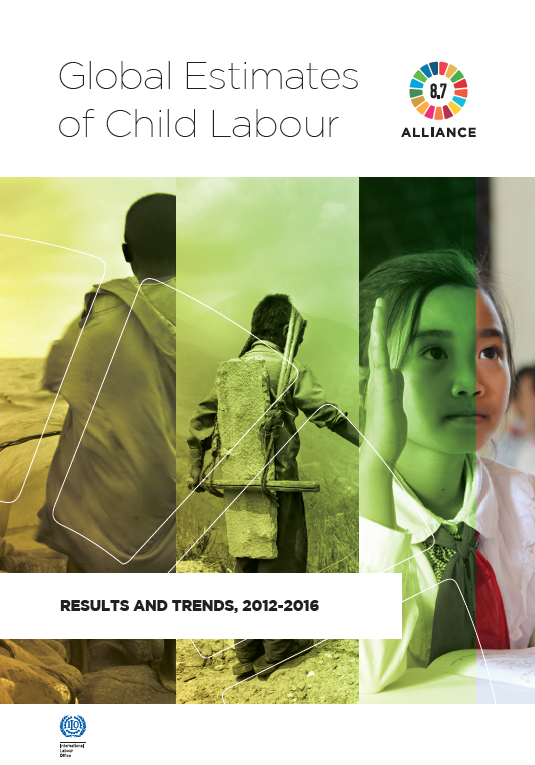
On 19 September 2017 in New York, the International Labour Organization launched two seminal reports: Global Estimates for Child Labour: Results and Trends, 2012 – 2016 and Global Estimates of Modern Slavery: Forced Labour and Forced Marriage. Following the multi-year, collaborative research project conducted with Alliance 8.7 Members, the Walk Free Foundation and the International Organization for Migration, the reports reveal what the ILO deems the “true scale of modern slavery around the world”. Notably, the Child Labour report highlights the importance of birth registration, specifically as it pertains to building a policy response to child labour for the road forward.
First, the report emphasizes that, “Free and compulsory education of good quality up to the minimum age for admission to employment is a key tool in ending child labour”, but also notes that the cost to the family is one of the primary barriers preventing educational access for children. In response, the report stresses the need for investment in child education and singles out the link between cash transfers, non-means-tested benefits, and birth registration as a viable method for offsetting “the indirect cost of children’s time in school”.
Second, the report acknowledges poverty, risks, and shocks to the family as the primary drivers behind child labour and says that “social security is critical to mitigating these vulnerabilities”. After emphasizing public employment programmes, health protections, unemployment protections, and basic income security as the basis for a well-designed social security system, the report ultimately concludes that “Birth registration, itself a key human right, is an essential starting point for ensuring coverage in all of these areas”.
News & Events

19 Sep 2017
ILO highlights the importance of birth registration for social protection
More News

30 December 2025
India is hosting a National Symposium and Stakeholder Consultation titled “Building a Mortality…
30 January 2026
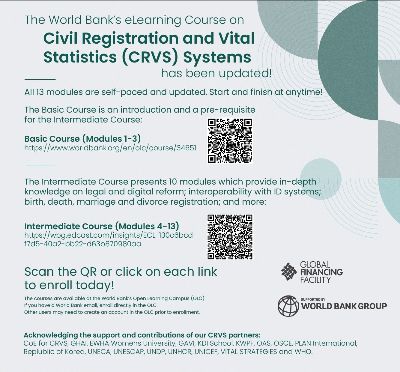
The World Bank has released an updated version of its free Civil Registration and Vital Statistics…
30 January 2026
In partnership with the Economic Commission for Africa (ECA) and Vital Strategies, the Economic and…
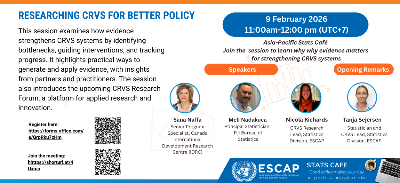
30 January 2026
ESCAP is hosting a new session of its Asia‑Pacific Stats Café Series on 9 February 2026, focusing…
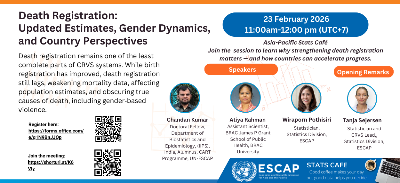
30 January 2026
ESCAP will convene another session of the Asia‑Pacific Stats Café Series on 23 February 2026,…
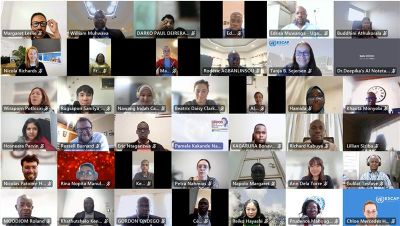
30 January 2026
On 20 January 2026, the third cohort of the CRVS Applied Research Training (CART) Initiative was…
30 January 2026
ESCAP has released a new Stats Brief on Regional estimates of death registration completeness: 2023…
30 January 2026
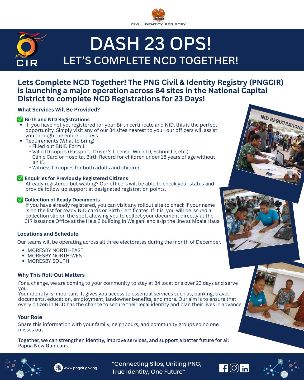
The Papua New Guinea Civil and Identity Registry (PNGCIR) has initiated DASH 23 OPS, an intensive…

30 January 2026
Vietnam has approved a new National Action Program on Civil Registration and Vital Statistics (CRVS…

30 January 2026
In the Solomon Islands, where nearly 80% of deaths occur outside formal health facilities, the…